



Wastewater Treatment System for Biogas Production
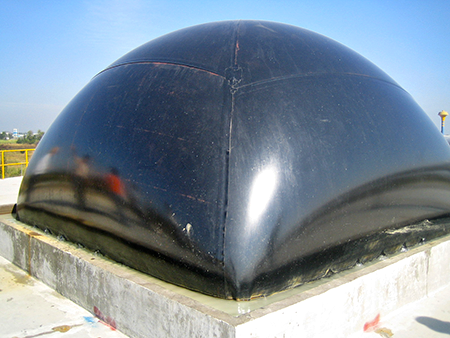
This anaerobic wastewater treatment’s unique feature is the microbes immobilized on the medium surface so that they can be retained at length. As a result, the system can simply eliminate over 80% of the organic matters in wastewater without the need of a costly chemical pre-treatment step. It is particularly suitable for agro-industrial wastewater with high level of suspended solids such as those from starch, fruit, and food factories. More importantly, it produces biogas which can be used to produce energy for the plant.
This system has already been installed in several types of industry:
• Starch factories: Cholcharoen, Chaiyaphum Plant Products, Northeastern Starch (1987) and Sima Inter Product
• Palm oil factory: Thachana Palm Oil
• Dry fruit / canned fruit factories: See Ong Hong Enterprise and Ruam Arharn
Factory operators interested to install this Wastewater Treatment System for Biogas Production can contact BIOTEC Excellent Center of Waste Utilization and Management (ECoWaste) for further consultation.
Improvement in Energy and Resource Efficiency in Cassava Starch Industry
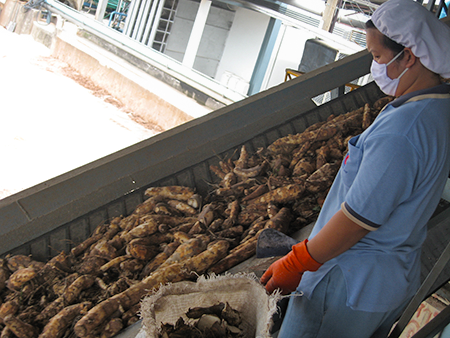
BIOTEC, NSTDA and King Mongkut’s University of Technology Thonburi has supported and conducted research and development to improve the production efficiency in the cassava starch industry, aiming to increase competitiveness of this industry in the global scene. The work involved water and energy audit; making an improvement on the production units to minimize starch loss and save energy and water; and the development of wastewater treatment reactor for biogas production.
With the collaboration with GIZ (German International Cooperation) and the Department of Industrial Promotion, the capacity building program was implemented, consisting of the developments of guidelines and practical training module for factory managers and operators, as well as the organizations of training workshops and establishment of cassava network. Twenty-four cassava starch factories have implemented this technology, and have reduced starch losses and saved considerable water and energy consumption.
Tubular Denitrification Reactor (TDNR)
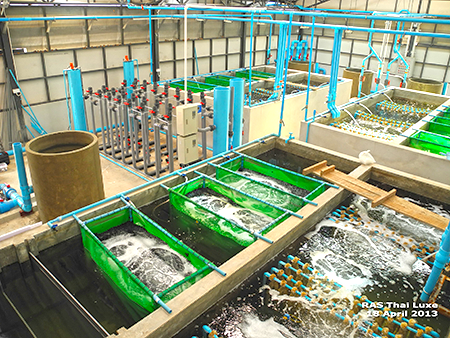
A closed aquaculture system is normally equipped with nitrification biofilter, which serves the purpose of converting highly toxic ammonia to nitrate. However, high concentration of nitrate causes stresses and affects reproduction of aquaculture, and thus the system still requires water exchange.
BIOTEC researcher has developed a Tubular Denitrification Reactor (TDNR) for nitrate removal. With TDNR, water can be recirculated within the system hence water exchange can be prolonged for a year or more.
This technology has already been licensed to a few companies with different applications. Aquatica Co., Ltd., an operator of aquarium retail and installation, uses TDNR in a large aquarium. Sea Born Co., Ltd. has TDNR installed in an intensive fish breeding tank; whereas Thai Luxe Enterprises Co., Ltd. in a feed-trial aquaria.
Bioremediation Agent
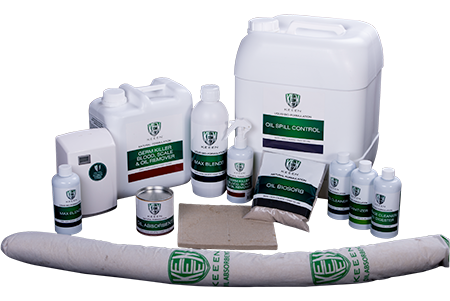
BIOTEC and KEEEN Co., Ltd. (previously known as Hi-Grimm Environmental and Research Co., Ltd.) collaborated on a joint research project to develop a commercial bioremediation product based on oil-degrading microbes. Under the project, BIOTEC researcher selected oil-degrading bacteria found in Thailand and developed culturing methods and media for the microbes.
Bioremediation agent, synergistic blends of oil-degrading microbes, is now made commercially available under the trade name “KEEEN”. KEEEN has a variety of formulas for applications in various industries such as petrochemical industry, automobile industry, hotels and hospitals.
ENZhance Detection Kit for Enzyme Activity from Microbial Samples
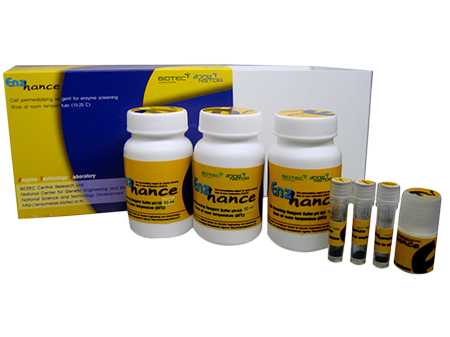
The applications of enzymes have surged dramatically in the past decades in wide-ranging industries such as animal feed, paper, detergent, food, and garment industries. There is a need for these enzyme users as well as the enzyme producers and researchers to be able to evaluate the enzyme performance. However, the traditional methods of evaluating enzyme activity have several drawbacks, namely time consuming, costly, and only sensitive to enzymes excreted outside of the cells. This enzyme activity detection kit has been developed with reagents to make bacterial cells permeable so that enzymes can be released for activity testing. It is fast, convenient-to-use, highly accurate, and versatile to different temperature and pH conditions. It can also be applied to bacterial screening for enzyme production.
For licensing this technology, please contact NSTDA Technology Licensing Office (TLO).
ENZstrip for Detection of Industrial Enzyme Activities
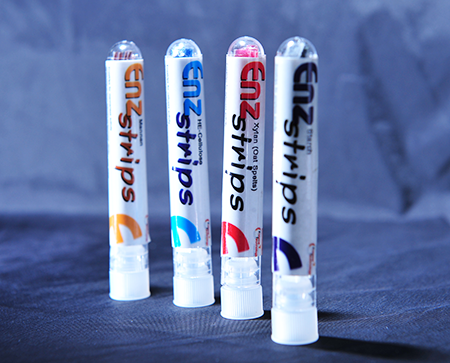
ENZstrip can detect enzyme activities beyond the cell-based environment. It is a simple, user-friendly, and sensitive tool to detect enzymes at various pH and temperature conditions without the need of special equipments or reagents. It allows users to detect the presence of certain enzymes and compare the relative enzymatic activity of different samples anywhere anytime without the laboratory confinement.
For licensing this technology, please contact NSTDA Technology Licensing Office (TLO).
ENZhance Lysis Buffer
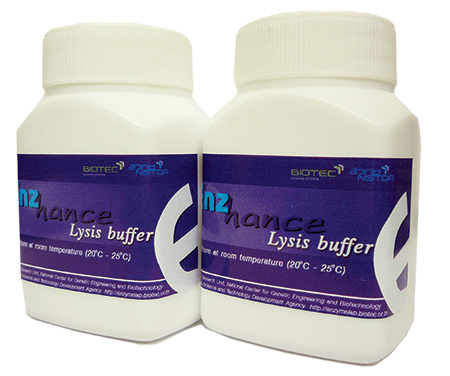
Researchers and technicians from universities, research laboratories, and biotech companies routinely extract proteins from microorganisms for both learning and commercial objectives. Normally either capital-intensive machines or costly imported lysis buffers are used to lyse the cells. Enzhance Lysis Buffer, with its patented formulation of surfactants, offers a more cost-effective solution to these specialists. In addition, it is fast and convenient to use. It is also mild enough so that the extracted proteins are intact. The product can also be applied to extract DNA from cells.
For licensing this technology, please contact NSTDA Technology Licensing Office (TLO).
ENZbleach: Alkaline–tolerant Enzyme for Pulp Bleaching Process
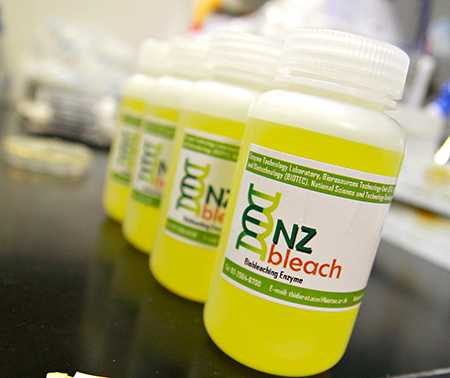
In a conventional chemical bleaching process in the pulp and paper industry, a large volume of chemicals is used, releasing pollution into the environment. The new biobleaching process using enzymes leads to a significant reduction of chlorine and chlorine-based compounds. The xylanase attacks hemicellulose and alters the interface between the cellulose and lignin, thereby facilitating the chemical extraction of lignin from pulp.
ENZbleach has been developed and optimized for pulp biobleaching without the need of pH adjustment of the pulp, which will make the large-scale operations more simple and cost effective. Moreover, ENZbleach is a cellulose-free xylanase, thus does not destroy the structure of cellulose and diminish pulp quality.
For licensing this technology, please contact NSTDA Technology Licensing Office (TLO).
Commercial Chemicals from Natural Product Discovery
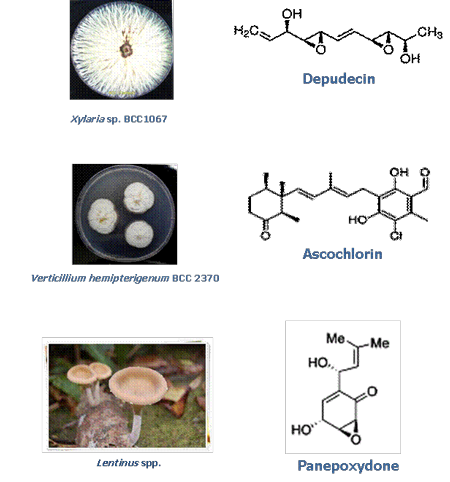
BIOTEC natural products research program searches for bioactive substances produced from various microorganisms, by using activity-guided fractionation and structure modification for increased biological activity. The focus has centered on insect pathogenic fungi as previous work has shown that they are an excellent source of chemical diversity, both in terms of structures and biological activities. This effort has resulted in a chemical library of pure compounds, chemical profile databases of crude extracts and a number of novel compounds published in international journals. These compounds can be further investigated for various industrial applications, such as in pharmaceutical and chemical industries.
BIOTEC has licensed the use of three microorganisms: Xylaria spp., Verticillium spp., and Lentinus spp. to Sigma Aldrich for commercial productions of depudecin, ascochlorin and panepoxydone, respectively.
iCollect: An Enhanced Solution for Biological Resources Management
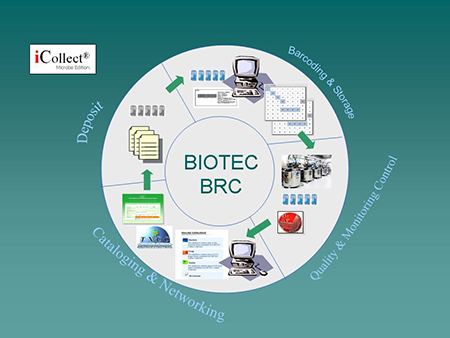
iCollect is a software to support the laboratory’s inventory management of biological collections. It allows users to create any type of sample containers and storage devices, store any type of samples and collections, graphically view the content of all levels of storages, generate and print barcode, easily aliquot/derive/extract any number of samples and search any information in the collection. Using the barcode assigned by iCollect, users can easily find a sample’s position in the storage, and add a sample to a selected storage position. The in and out movement of samples in the storage are recorded and tracked for audit trail. In the graphical tree view of the samples, users can trace the aliquot/sample back to its original parent.
iCollect is currently supporting the laboratory’s inventory management of biological collections at Bioresources Technology Unit and an integrated biodiversity database of Ministry of Science and Technology.
Phytoremediation of Saline Land
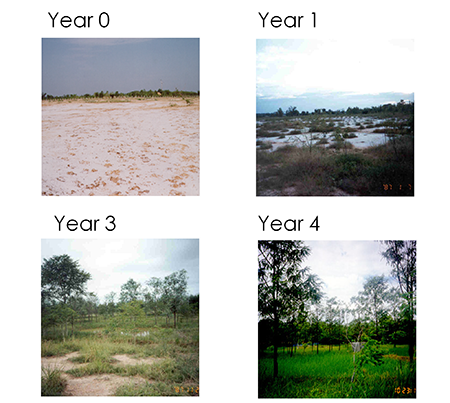
Phytoremediation is one of the effective strategies to prohibit the distribution of salt. However, the lack of salt-tolerant plants and good agricultural practices are an important barrier to solve this problem. Using the in vitro environmental control system, research team identified a number of salt-tolerant varieties of tropical plants, as well as some economic crops like rice and forest trees.
The technology, a combination of identified salt-tolerant crops from BIOTEC Laboratory and an application of soil treatment with organic and mineral supplement has been implemented on a 20-acre old salt-mining site in Nakhon Ratchasima Province and a 40-acre site in Sakon Nakhon and Udon Thani Provinces. The omplementation has been done in collaboration with various government agencies and private sector such as Pimai Salt Co., Ltd. and SCG.
ENZease: Duo-activity Enzyme for One-step Biodesizing and Bioscouring Process of Cotton Fabrics
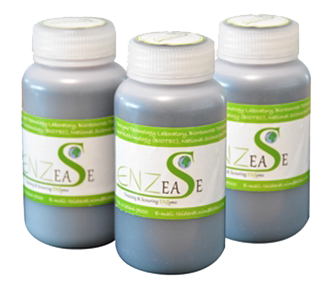
ENZease is a duo-activity enzyme for one-step biodesizing and bioscouring process of cotton fabrics. It contains amylase and pectinase activities which are capable of working at the same pH and temperature range. It was established to replace the conventional chemical process and combined the desizing and scouring steps of cotton fabrics. The use of ENZease provides many benefits that could not be obtained from the conventional two-stage pretreatment process using chemicals and/or other commercial single-activity enzymes currently available in the market. ENZease is able to lower chemical consumption, minimize step in the process, shorten treatment time, and thus reduces operational cost and space, making the large-scale operation more simple and cost effective.
ENZease was co-developed by BIOTEC, in collaboration with MTEC and Thanapaisal R.O.P., a local textile company.
This technology is available for licensing. For further information, please contact BIOTEC Business Development Division.
Onsite Microbial Reactor for Biological Wastewater Treatment System
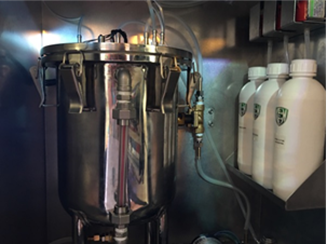
OMR allows an on-site production of microorganism used in the treatment of wastewater, especially wastewater with high oil content. The 10-L reactor is equipped with automatic aerator as well as a suitable culture medium to produce oil-degrading microorganisms within 24 hours. OMR has been tested in several factories, and the effluent from the factories has met the discharge requirements. This technology eliminates the cost of packaging and transportation of bioremediation agents, making it suitable for industrial sites that need to regularly manage oil-contaminated wastewater.
OMR was the result of collaboration between BIOTEC and KEEEN Limited. The reactor is manufactured commercially by KEEEN Limited.
Portable Dissolved Oxygen Test Kit
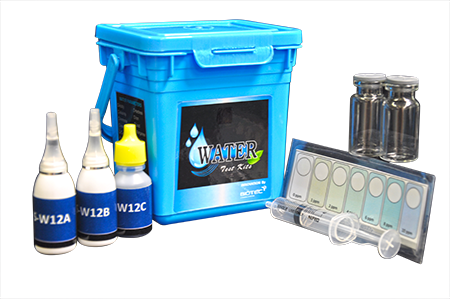
Dissolved oxygen is essential for the maintenance of healthy lakes and rivers, and aquatic plants and animals need oxygen to survive. An easy-to-use and accurate method to measure dissolved oxygen would be a useful tool for monitoring water quality in natural reservoirs, aquariums and aquaculture farms.
To fill this need, BIOTEC researcher developed a portable dissolved oxygen test kit. The kit offers an accurate reading of dissolved oxygen concentration in a water sample in a simple 3-minute procedure based on a colorimetric reaction with redox dye.
This technology has been licensed to Eco Scientific Co., Ltd. for commercialization.